Maternal Care Access Rankings Put Wyoming Last and Vermont First
Wyoming ranks last and Vermont first across six care measures; insurance gaps and provider shortages weigh on access, while infant mortality adds context.

Access to prenatal and maternal care varies sharply by state, and the gap reflects more than the number of available specialists. Insurance coverage, regular access to a primary care provider, prenatal care rates and hospital practices all shape the picture. In LendingTree’s comparison of 49 states, Wyoming ranked last and Vermont first; Rhode Island was excluded because new quality data weren’t available.

The analysis separates access from quality. Four measures determine the access score, while two measures assess quality. That distinction matters: a state can have relatively strong scores on some measures and still rank poorly when coverage or provider availability is limited. Infant and maternal mortality rates offer further context, but they aren’t part of the ranking calculation.
Regional gaps and the role of coverage
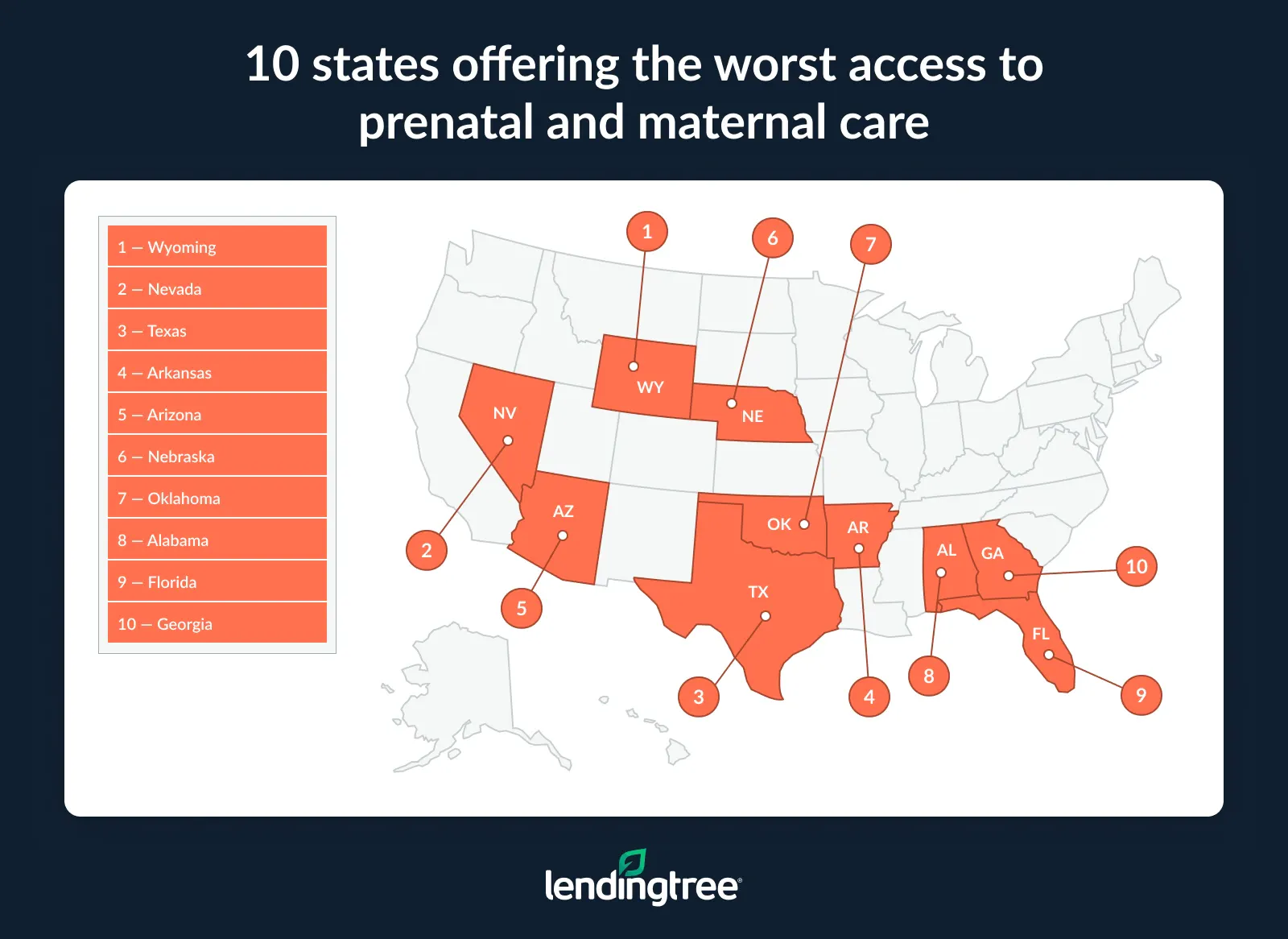
Six of the 10 lowest-ranked states are in the South: Texas, Arkansas, Oklahoma, Alabama, Florida and Georgia. The regional concentration points to persistent differences in coverage and provider access. LendingTree health insurance expert Cate Deventer says Medicaid expansion status can affect whether pregnant people qualify for coverage. Even with coverage, a patient may have few in-network specialists nearby.
“Even having Medicaid, group insurance or private insurance doesn’t guarantee that an OB-GYN is accessible,” Deventer says. Network limits and local provider supply can leave patients with few practical options. In rural areas, longer trips to appointments may add time and expense, and patients may turn to out-of-network providers.

Texas illustrates how coverage and routine care access can reinforce each other. Only 77.5% of women ages 18 to 44 in the state have insurance, the lowest rate in the country and 10.9 percentage points below the national figure of 88.4%. The share with a primary care provider is 66.0%, second-lowest among states. Adequate prenatal care is recorded for 67.7% of births, also among the weakest results.
Without coverage, patients may need to pay directly for visits, tests and other maternity care. Deventer says cost can lead some people to skip appointments or tests. For those who have a plan, she recommends checking whether the preferred doctor and hospital are in network, reviewing deductibles and other out-of-pocket costs, and confirming whether referrals or prior authorization are required.
Wyoming’s slide to the bottom
Wyoming fell from 40th place in LendingTree’s 2024 comparison to 49th in the latest ranking. Its average Merit-based Incentive Payment System score among OB-GYN specialists was 76.9, compared with 85.5 nationally. The state’s average hospital maternity practice score was 73, against a national average of 82. MIPS scores measure care quality under Medicare.
Several access figures add to the challenge. Insurance covers 82.2% of Wyoming women ages 18 to 44, while 73.7% have a primary care provider. The state has 45.6 maternal care providers per 100,000 women ages 15 and older. Those averages don’t show how providers are distributed within the state, but they help explain why distance can matter, especially for rural patients.
The full bottom 10 ranking shows how different weaknesses can lead to a similar result. Nevada is 48th, followed by Texas at 47th, Arkansas at 46th and Arizona at 45th. Nebraska ranks 44th, Oklahoma 43rd, Alabama 42nd, Florida 41st and Georgia 40th. Their results vary across coverage, provider availability and quality scores; no single measure explains every state’s position.
Infant mortality adds a separate measure of outcomes
Mississippi didn’t place in the bottom 10 for access and quality, yet it had the highest infant mortality rate: 9.7 deaths per 1,000 live births, compared with 5.5 nationally. The rate is a separate indicator, outside the six measures used for the state rankings, and offers another view of maternal and infant health.
Arkansas recorded 8.3 infant deaths per 1,000 live births, followed by Delaware at 7.8, Louisiana at 7.6, South Carolina at 7.5, Oklahoma at 7.4, South Dakota at 7.3, Alabama at 7.1, Alaska at 6.8 and Ohio at 6.7. At the other end, New Hampshire had the lowest rate, 3.0. New Jersey was at 3.4 and Massachusetts at 3.5; these were the only other states below 4.0.
The national maternal mortality rate was 17.9 deaths per 100,000 live births in 2024, up 2.9% from 17.4 in 2018. Like infant mortality, this figure wasn’t included in the access and quality scoring. It provides context on outcomes, but the ranking itself measures coverage, care access and selected quality indicators.
New England leads the upper tier
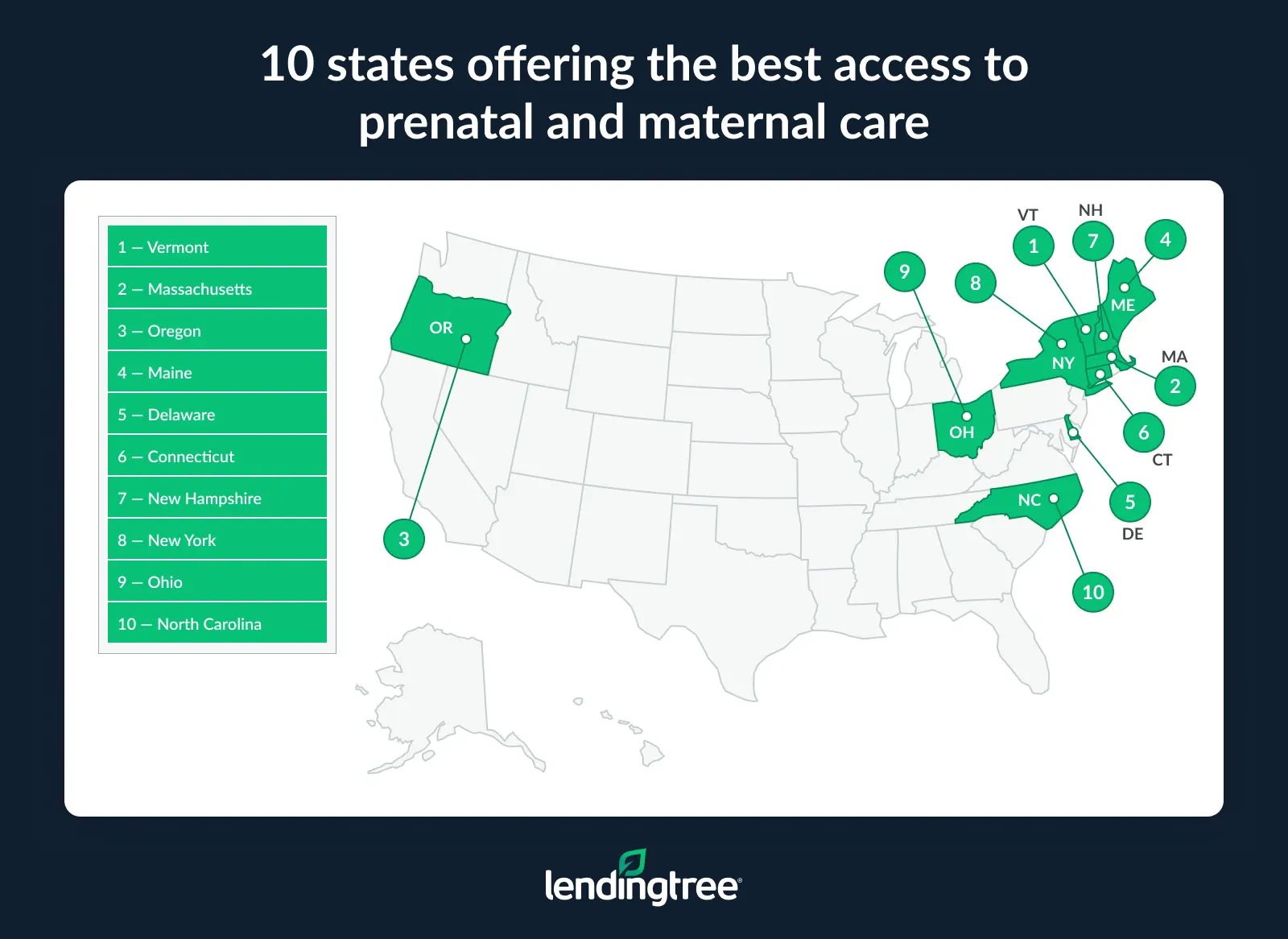
New England accounts for five of the 10 highest-ranked states. Vermont is first and Massachusetts second; Maine ranks fourth, Connecticut sixth and New Hampshire seventh. Oregon, in third place, has the highest concentration of maternal care providers among the top 10, at 72.5 per 100,000 women ages 15 and older. North Carolina is 10th and the only Southern state in the group.
Individual strengths differ across the leading states. Maine has the highest primary care provider rate in the country, at 90.6%, and an OB-GYN MIPS score of 92.3. Connecticut reports 93.0% insurance coverage and a hospital maternity practice score of 88. New Hampshire has the highest adequate prenatal care rate among the top 10, at 87.2%. Massachusetts reports 95.8% insurance coverage and an OB-GYN MIPS score of 88.9.
Vermont rose from sixth place in 2024 to first. It exceeded the national average on all six ranking measures. Adequate prenatal care covered 86.8% of births, compared with 75.0% nationally. The state’s other reported figures include 96.0% insurance coverage among women ages 18 to 44, an 89.7% primary care provider rate, 69.3 maternal care providers per 100,000 women ages 15 and older, an OB-GYN MIPS score of 90.7 and a hospital maternity practice score of 90.
What the ranking measures
LendingTree calculated an access score from four equally weighted measures: the percentage of women ages 18 to 44 with health insurance; the percentage in that age group with a primary care provider; the number of obstetricians, gynecologists and midwives per 100,000 women ages 15 and older; and the percentage of live births receiving adequate or better prenatal care.
The quality score uses two equally weighted measures: the average MIPS score among OB-GYN specialists and the average state Maternity Practices in Infant Nutrition and Care score among hospitals. The final ranking combines the access and quality results. Rhode Island was left out because new quality data weren’t available.
The analysis drew on the March 2025 Current Population Survey; the 2022-23 Behavioral Risk Factor Surveillance System; provider data from September 2024; March of Dimes PeriStats for 2024; 2024 hospital maternity practice reports; and KFF data. The mortality figures came from separate Centers for Disease Control and Prevention data and reports.
For patients, the state rankings provide a broad comparison, not a guarantee of local availability or a measure of any individual’s care. The figures point to the factors that can shape access: whether coverage is in place, whether a clinician is reachable through a plan, how far patients must travel and how local hospitals perform on maternity practices. Those details are where statewide averages meet the realities of care.