Home Repair Delays Strain Household Budgets and Can Raise Costs
A survey finds 34% of homeowners delayed repairs in two years; many face higher bills, tighter budgets and unresolved work.

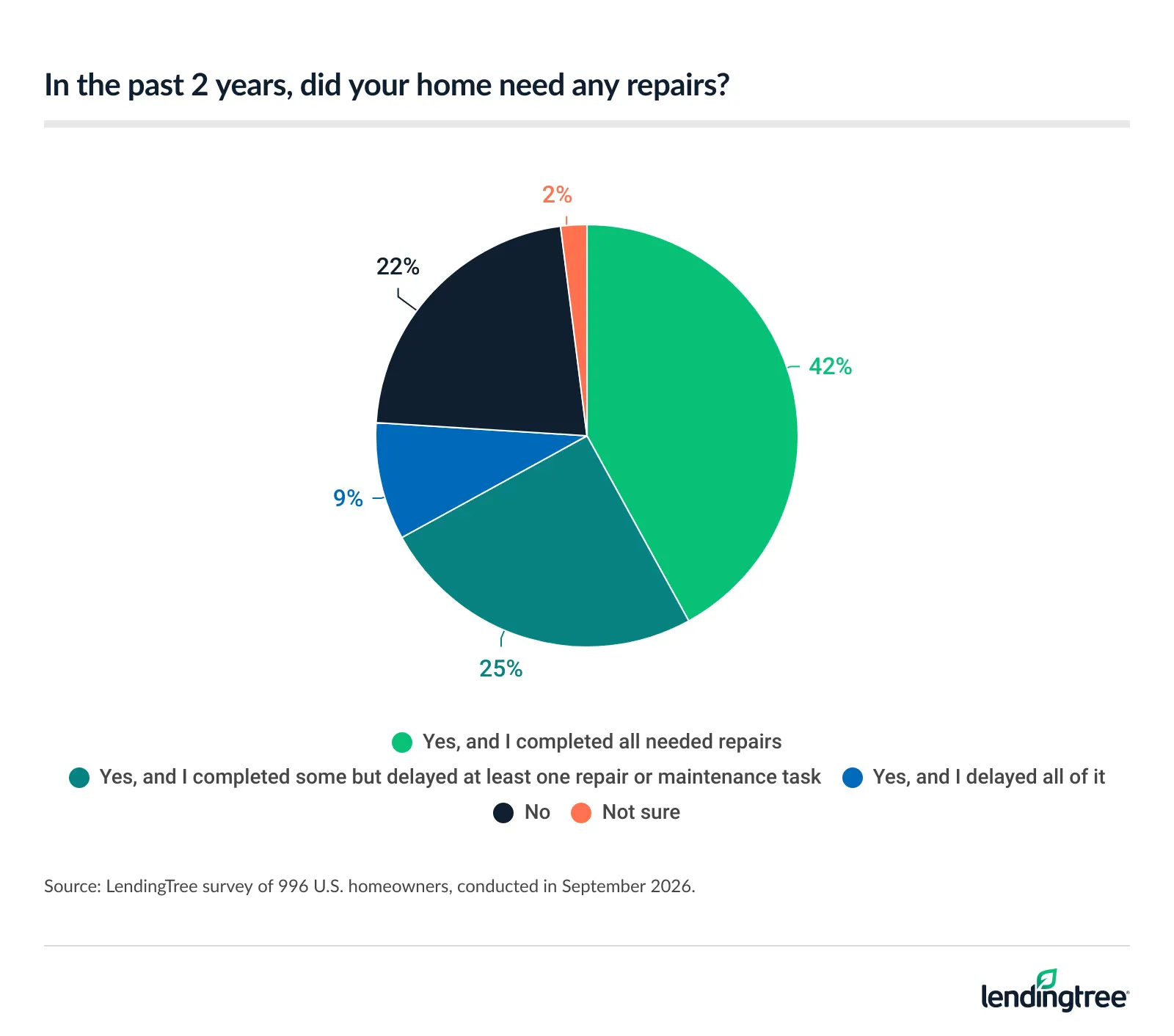
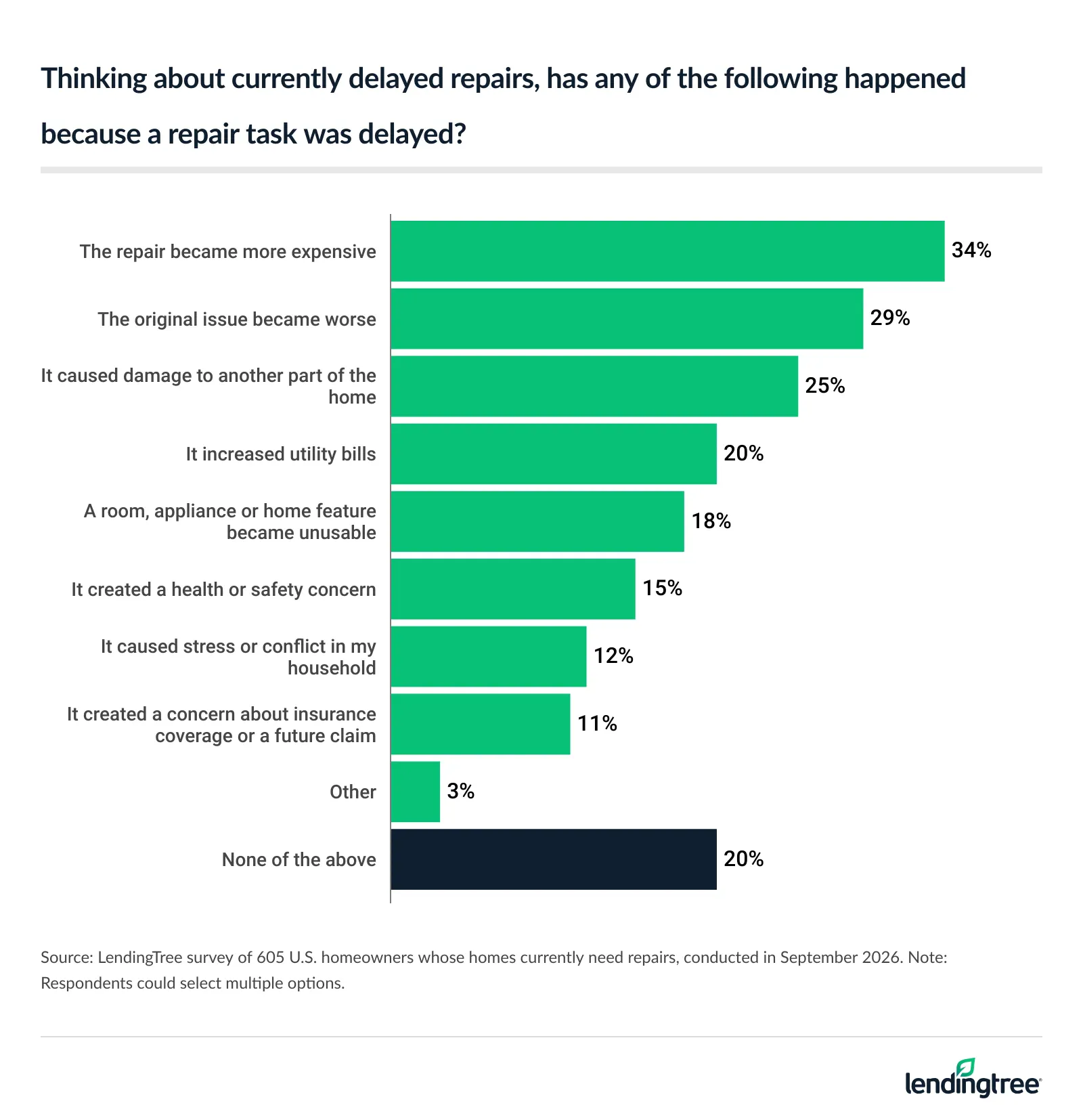
For many homeowners, the cost of maintaining a home is competing with everyday expenses and savings goals. In a LendingTree survey, 34% said they had delayed at least one repair or maintenance task in the past two years. Among those with repairs still outstanding, 34% said the delay had made the work more expensive, and 29% said the original problem had worsened.

The findings point to a bind: putting off work can preserve cash in the short term, yet leave households exposed to larger bills or damage elsewhere. The survey also shows how unevenly that pressure falls. Younger homeowners were more likely to report urgent or safety-related repairs, while homeowners with children were more likely to have cut essential spending or drawn on emergency savings to pay for work.
Cost and contractor quotes keep repairs on hold
Among all homeowners surveyed, 25% had completed some repairs while delaying at least one, and 9% had delayed all needed repairs. Another 42% said they had completed all repairs they needed. For homeowners with current outstanding work, the leading reported obstacles were saving up for repairs (34%), being unable to afford them (32%) and finding contractor quotes too high (23%).
Other barriers included waiting for an insurance decision or payment (21%), difficulty finding an available or affordable contractor (16%), and planning to do the work themselves but not having started (15%). Time constraints and a belief that the problem was not urgent each accounted for 12%. Some respondents cited disruption, uncertainty about whom to hire, or a desire to see whether the issue worsened. Inability to obtain financing was reported by 3%.

The work being delayed spans routine and potentially substantial repairs. Flooring, walls or ceilings led the list at 30%, followed by bathroom or kitchen work at 29% and plumbing, water heater or sewer and septic issues at 27%. Roof, chimney or gutter repairs were reported by 25%, while heating or air conditioning work accounted for 23%.
Water damage, leaks or mold were cited by 19%; windows or exterior doors by 16%; and electrical work by 15%. Major appliances, foundations or other structural issues, and exterior siding, paint, decks or fencing each appeared in the survey results. Routine maintenance accounted for 9%, while safety features such as smoke alarms and carbon monoxide detectors and pest problems each accounted for 6%. Accessibility or mobility-related repairs were reported by 4%.
Among homeowners who had needed repairs in the past two years, 36% described their most serious outstanding repair as important but not urgent. Another 27% said it was urgent or safety-related. That share was higher among millennials ages 30 to 45, at 39%, and Gen Z homeowners ages 18 to 29, at 34%, than among Gen X homeowners ages 46 to 61, at 26%, or baby boomers ages 62 to 80, at 12%.
Repair bills compete with savings and essentials
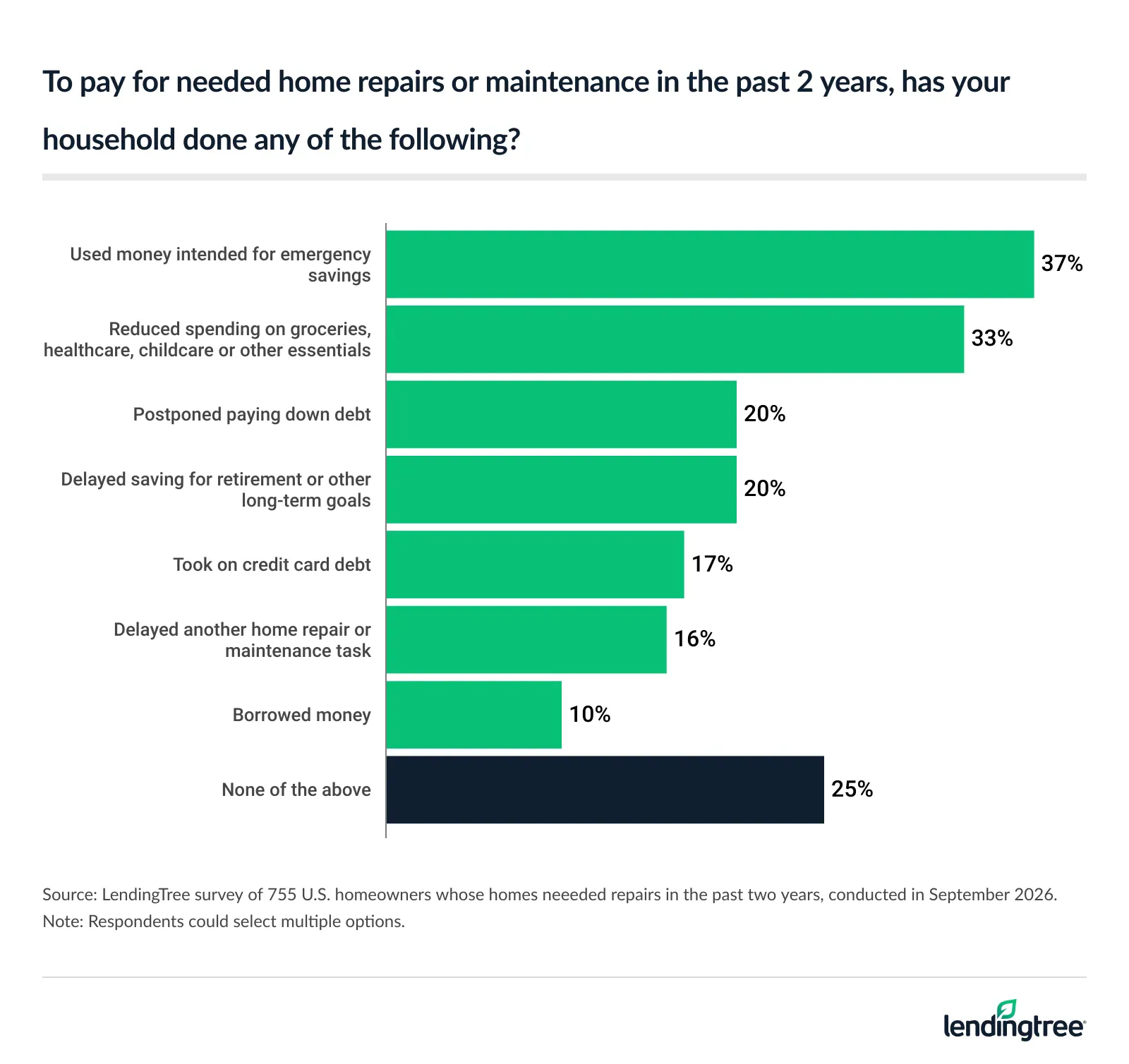
Households that needed repairs in the past two years often paid for them by redirecting money from other priorities. Some 37% used emergency savings, 33% reduced spending on essentials such as groceries, healthcare or childcare, and 20% postponed retirement saving or debt repayment.
The strain was more pronounced for younger homeowners in the survey. Among those who needed repairs, 61% of Gen Z homeowners and 46% of millennials said they had cut essential spending to cover the work. The comparable shares were 18% for Gen X homeowners and 16% for baby boomers. Among homeowners with children under 18 who needed repairs, 48% had cut essential spending and 48% had used emergency savings.
A hypothetical $5,000 repair also exposed limited room in many household budgets. Across all homeowners, 30% said they could cover that bill only by significantly reducing savings, while 25% said they could not cover it. Those responses suggest that even homeowners who have completed repairs may have little financial slack for an unexpected job.
Matt Schulz, LendingTree’s chief consumer finance analyst and author of “Ask Questions, Save Money, Make More: How to Take Control of Your Financial Life,” said home costs extend beyond the purchase price. He argued that planning for maintenance and keeping money available for unexpected repairs can reduce the chance that a household must turn to debt or sacrifice other priorities.
Schulz also described emergency savings as a buffer against surprise expenses. Paying down card balances without setting aside money for emergencies can leave a household relying on credit again when an unexpected bill arrives, he said. The survey does not measure how much respondents had saved or how they financed each repair, but its reported trade-offs show that repair spending can draw directly from both short-term reserves and longer-term plans.
Delays can add expense and spread damage
Among homeowners who currently needed repairs, 34% said waiting had increased the cost, 29% said the original issue had grown worse and 25% said the delay had caused damage elsewhere in the home. These are respondents’ reported experiences, rather than estimates of the average extra cost caused by postponement.
Schulz used a roof leak as an example of how a limited problem can lead to water damage, mold or structural trouble if it is left unresolved. He said a worsening issue can leave homeowners with fewer choices about timing and repairs, including when they decide to sell. That risk matters particularly where the household already faces cost barriers: a delay may preserve cash today while making later work more extensive.
The expected bills are substantial for many households with current repairs. In that group, 68% estimated that the outstanding work would cost at least $1,000, and 26% expected a bill of $5,000 or more. Meanwhile, 61% said they were at least somewhat concerned that continued delay could make the work more expensive or create a safety risk.
Some outstanding work has lingered for a year or longer
Repair delays can stretch well beyond a few weeks. Among homeowners with current repair needs, 25% said their oldest delayed job had been waiting for four to six months, and 22% put the delay at one to three months. Nearly a quarter, 24%, said their longest-delayed repair had remained unaddressed for at least a year.
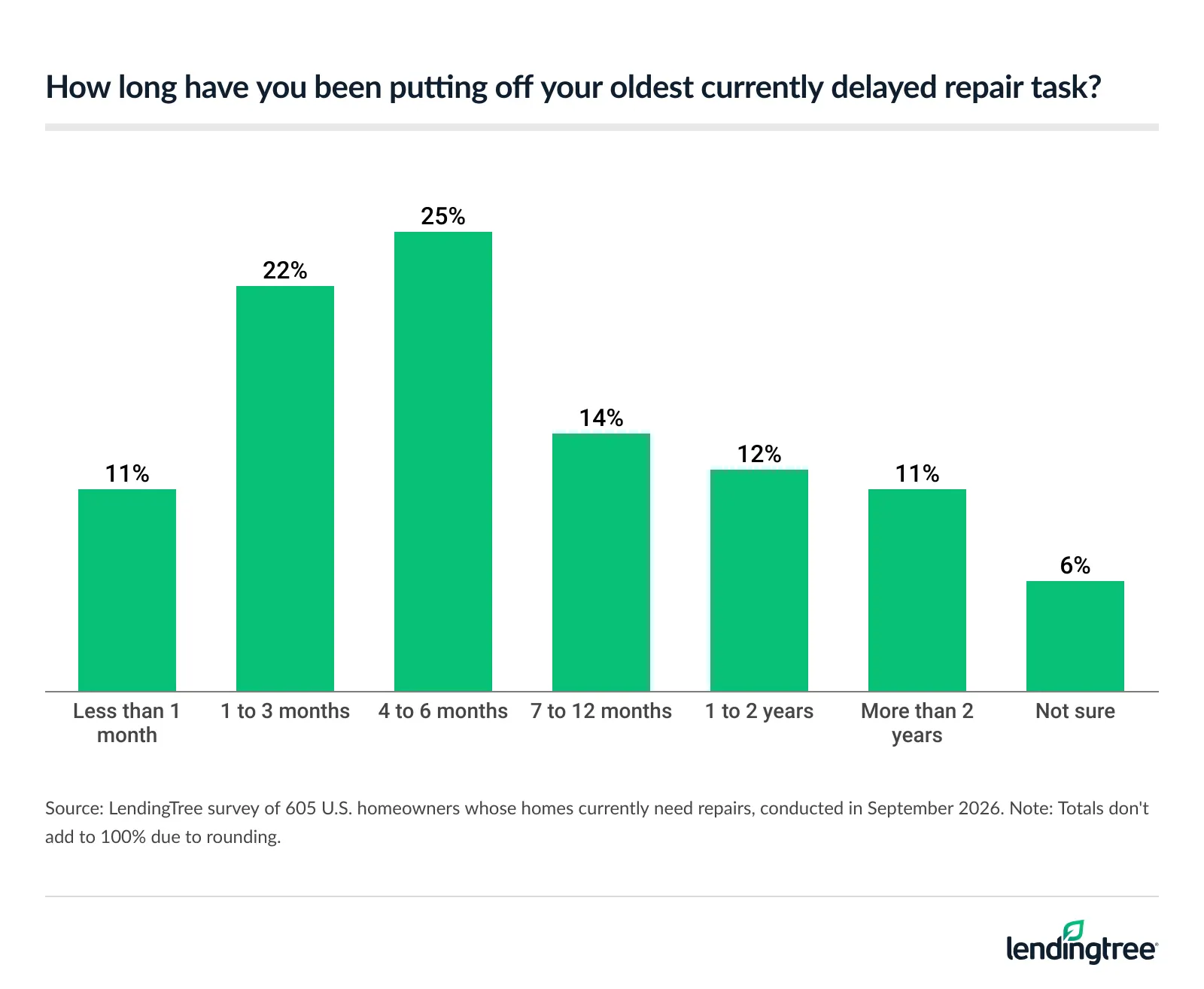
Long delays were especially common among baby boomers with outstanding work: 46% said their oldest needed repair had been delayed for at least a year. The same was true of 35% of homeowners earning less than $30,000. The survey identifies these differences but does not establish why particular repairs remain unresolved.
Schulz pointed to several possible pressures, including feeling overwhelmed, uncertainty about hiring a contractor, reluctance to borrow, and the desire among some older homeowners to preserve retirement savings. He also said a professional might identify a smaller interim step when a household cannot afford the full repair immediately. That possibility underscores how the timing and scope of work can matter alongside the eventual bill.
Respondents were not uniformly pessimistic about clearing their backlogs. Over the next 12 months, 38% of homeowners with current repair needs expected to complete all delayed repair or maintenance work, while 48% expected to finish some or most of it. Those expectations indicate plans, not completed work; costs, contractor availability and household finances could affect whether projects proceed.
DIY work helps some households manage costs
Among homeowners who had needed repairs in the past two years and completed at least some of them, 60% said they had done some of the work themselves because they could not afford professional help. The share was 72% among millennials, compared with 29% among baby boomers. It was also 73% among homeowners with children under 18, against 59% among those without children and 43% among those whose children were 18 or older. Men reported doing repair work themselves for cost reasons more often than women, at 68% versus 49%.
Schulz said do-it-yourself work may suit lower-risk cosmetic jobs such as painting or caulking, but he urged caution around electrical, gas, structural, roofing and major plumbing tasks, as well as work involving mold, asbestos, permits or serious fall risks. Mistakes in those areas can cause injury or additional damage, and may complicate insurance matters or a later sale, he said. The survey measures homeowners’ reported choices; it does not establish whether the work was successful or what it would have cost to hire a professional.
Survey scope and household planning
LendingTree commissioned QuestionPro to survey 2,000 U.S. consumers online from Sept. 2 to 7, 2026. The sample was nonprobability-based, with quotas intended to help it reflect the overall population. Researchers reviewed responses for quality control. The results describe respondents’ reported experiences and expectations; they should be read in light of that sampling method.
For the survey’s age groups, Generation Z meant ages 18 to 29 in 2026, millennials 30 to 45, Generation X 46 to 61, and baby boomers 62 to 80.
Schulz’s suggestions included setting aside money for repairs, checking a home regularly for emerging problems, and comparing written estimates before agreeing to work. He recommended collecting at least three contractor estimates and comparing available financing offers, including home improvement financing and home equity loans. These steps do not remove the affordability gap documented in the survey, but they reflect the decisions homeowners may face as repairs compete with other household needs.
The central financial tension is clear in the responses: a third of homeowners delayed work, while many of those with open repairs reported worsening problems, higher costs or damage elsewhere. Whether households can clear that backlog will depend on their budgets and access to affordable, available repair work.
===assistantfinal