54% of Digital Wallet Users Save One Payment Method, Limiting Choice at Checkout
Most wallet users keep one payment method saved. Survey data show why adding a second option may matter before checkout.
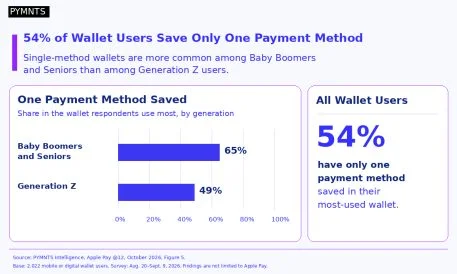
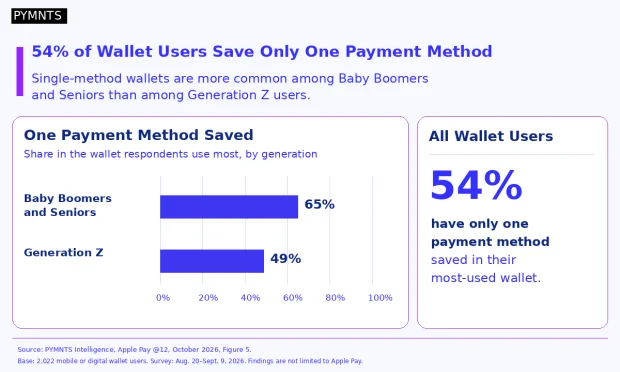
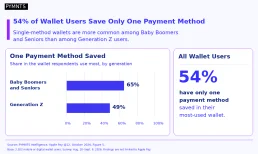
For most digital wallet users, the payment choice is made well before checkout: 54% keep only one payment method in the wallet they use most. That leaves card issuers competing for a spot in a customer’s wallet before a purchase begins, rather than relying on a last-minute prompt to change the payment choice.

The figures come from an October 2026 PYMNTS Intelligence report, “Apple Pay @12: Mobile Wallets Gain Ground, but Most Shoppers Still Tap a Card.” The survey covered 2,458 U.S. consumers. Its findings on saved payment methods include mobile and digital wallet users broadly, including people using peer-to-peer apps such as Venmo and Cash App; they aren't limited to Apple Pay users.


Wallet presence shapes the choice set
Another 5% of wallet users have multiple methods saved but always use the default, the option presented first. Only about 4 in 10 switch between saved methods. Taken together, the findings suggest that having a payment method stored in a wallet doesn't necessarily mean it competes for each transaction. For customers with one saved option, there’s no alternative to select within that wallet. For those who stick with the default, the other saved methods may rarely enter the decision.
That distinction matters for card issuers and wallet providers. A payment offer displayed at checkout can influence a customer only if the customer is still choosing among options. If the wallet contains one method, or the user routinely accepts the default, the opportunity to affect payment selection may come earlier: when the customer decides which cards to save and which to make primary.
The report describes the wallet consumers use most, not every wallet or payment account they hold. A person with one method in a primary wallet may have other cards in another app or account. The figures therefore measure the choice set within the most-used wallet, not the full number of payment methods a person owns.

Age gaps narrow the interpretation
Wallet users’ saved-payment habits differ by generation. Among baby boomers and seniors who use wallets, 65% have only one payment method saved. The share is 49% among Generation Z users, a gap of 16 percentage points. Younger users are more likely to have multiple options, but nearly half still keep just one in their most-used wallet.
That pattern cautions against treating digital wallet adoption as evidence that users are actively comparing cards at the point of payment. A wallet can make a payment method easier to use while also making repeat use of the same method more routine. The survey’s age comparison shows variation in how many methods users store, but it doesn't establish why those differences occur.
Many choices happen before checkout
Among 820 users with multiple saved methods who do more than simply use the default, 40% choose their payment method before checkout. Another 27% make the choice at checkout, while 21% decide both before and at checkout equally. The remaining 12% don't plan the choice.
These results make timing central to efforts to influence payment selection. A prompt shown only at the payment screen may arrive after many users have settled on a method. For businesses seeking to encourage use of a particular card, the findings point to two separate hurdles: getting the card saved in the wallet and making it salient when customers decide how to pay. The survey doesn't quantify how effective any particular prompt or offer would be.
Rewards remain a reported consideration. Seventy percent of wallet users say they are likely to use the card that earns the most rewards. But that stated preference sits alongside the prevalence of single-method wallets and default use. Wanting the best rewards doesn't guarantee that a user has saved several cards or revisits the choice at each purchase.
For issuers, the data put wallet enrollment and payment behavior in the same frame. A second saved method creates a possible alternative; it doesn't ensure that the customer will switch. The next questions are whether users add more options, how often they reconsider their default, and whether reward differences are enough to change behavior once checkout begins.