Copper Stockpiles in the US Mask Tighter Supplies in Other Markets
Nearly 70% of visible exchange copper stocks sit in the US, complicating surplus forecasts as physical premiums rise elsewhere.
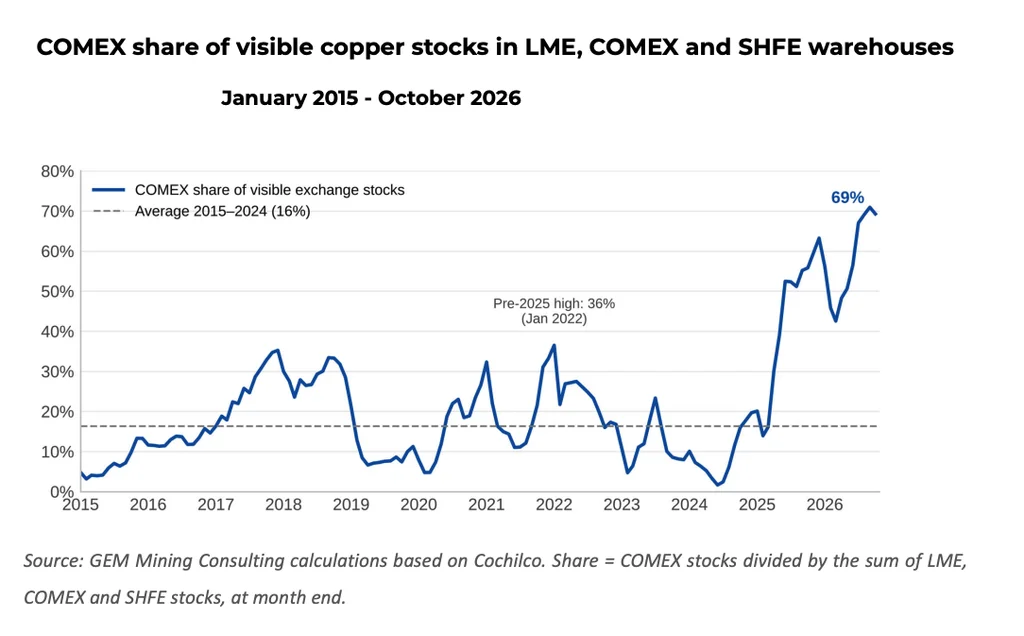
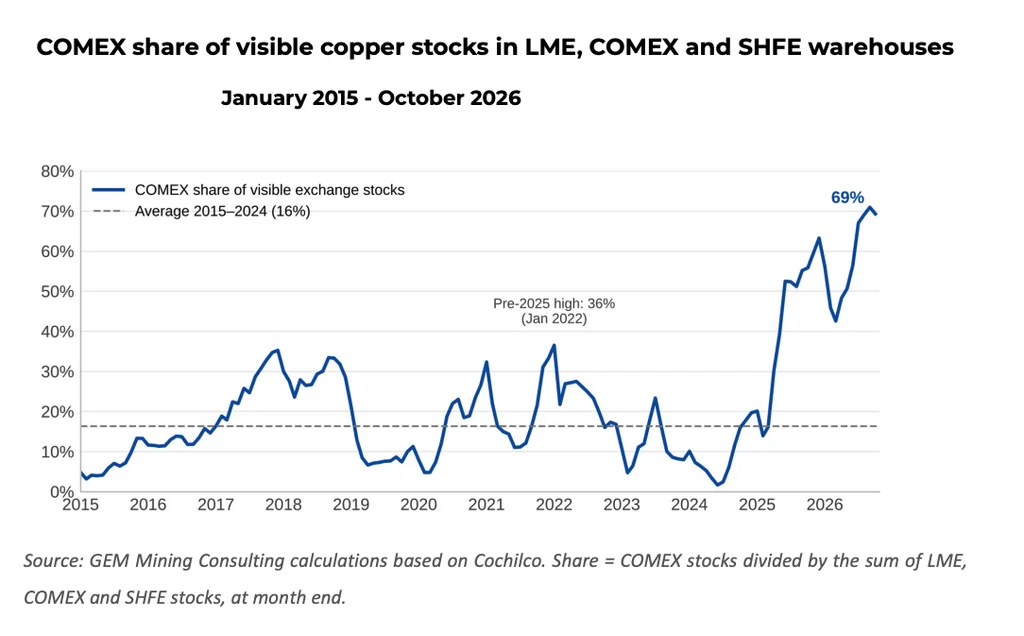
The copper market’s headline stockpile has grown sharply, but its location makes the global balance harder to read. Nearly 70% of visible exchange copper stocks are in the US, while inventories on the London Metal Exchange and Shanghai Futures Exchange remain below their recent average. That split helps explain why forecasts for 2026 range from a global surplus to a substantial shortfall outside the US.
Global inventories reached 1.04 million tonnes in October, up 83% from a year earlier, according to a study by GEM Mining Consulting. The figure suggests ample supply at first glance. But exchange inventories don’t tell the whole story when a large share of the metal is held in one region and buyers elsewhere face higher costs to secure physical copper.
The difference is reflected in sharply conflicting estimates. The International Copper Study Group projects a refined copper surplus of 104,000 tonnes in 2026, while Goldman Sachs estimates a deficit of roughly 950,000 tonnes outside the US and expects prices to reach $14,700 per tonne by year-end. Those projections use different market boundaries, but their divergence underlines how much the location of stocks matters.
Stocks have shifted toward US warehouses
GEM analyst Patricio Faúndez, using data from the Chilean Copper Commission, found that COMEX warehouses held 718,000 tonnes of copper in October. That represented 69% of visible stocks across COMEX, the LME and the Shanghai Futures Exchange. From 2015 through 2024, COMEX held an average of 16% of those exchange inventories, and its share never rose above 36%.
The current COMEX stockpile is roughly twice the exchange’s previous high in the historical series, which dates to 1990. By comparison, combined LME and Shanghai inventories stood at 319,000 tonnes, 11% below their average for 2015–2024. That total includes nearly 130,000 tonnes in LME warehouses in New Orleans and Baltimore, according to reports cited in the study. Excluding those locations leaves approximately 190,000 tonnes of visible exchange copper outside the US.
These figures describe exchange stocks, not all copper available to consumers. Still, the regional breakdown matters: a warehouse surplus in one market can sit alongside scarce immediately available material in another. Moving metal between regions takes time and money, and uncertain future duties can make a shipment hard to reverse.
Trade uncertainty kept metal in the US
The accumulation accelerated after the US began examining copper imports in February 2025, prompting traders to move metal into the country ahead of possible tariffs. From February through July 2025, COMEX copper traded at an average premium of about $1,120 per tonne over LME prices. The monthly spread reached $2,230 in July.
The premium fell sharply after refined copper cathodes were excluded from a 50% import tariff announced on July 30, 2025. Yet the inflow continued. Faúndez found that 77% of the 633,000 tonnes added to COMEX inventories since February 2025 arrived after that announcement. From August 2025 through September 2026, the spread averaged $156 per tonne, close to its 2024 average of $151.
That pattern points to uncertainty as a force in the physical market beyond short-term price arbitrage. When traders can’t tell whether refined copper will face future duties, keeping metal in US warehouses may appear less risky than sending it elsewhere. The current COMEX premium is too small to make overseas shipments back especially attractive, while the prospect of new duties could change the economics again.
The US has left open the possibility of tariffs on refined copper of 15% in 2027 and 30% in 2028. A Commerce Department update was due in June 2026, but the study says no subsequent decision has been published. The next decision on those duties could therefore affect both where copper is stored and how readily stocks reach buyers outside the US.
Physical premiums point to regional pressure
Market indicators in China suggest that available material is tightening. BMO Metals and Mining researchers have pointed to a Yangshan cathode premium above $200 per tonne and record Shanghai premiums for non-registered equivalent cathodes. They also flagged a gap between relatively muted futures price movements and rising costs in the physical market.
Speculative positioning has remained cautious ahead of the US midterm elections, according to the source. That contrast matters for interpreting prices: futures trading can reflect expectations and positioning, while physical premiums capture what buyers are paying to secure material for delivery. Neither measure alone settles the supply outlook, but together they show why warehouse totals and traded prices can send different signals.
Supply risks add another source of uncertainty. BMI, a unit of Fitch Solutions, has warned that drought linked to El Niño could contribute to electricity shortages in the Democratic Republic of Congo and Zambia, two major copper-producing countries. The source does not establish that these risks have already reduced output. It also reports increased oversight of artisanal mining in the DRC, another development that adds uncertainty without demonstrating an immediate change in production.
A trial shipment of 12,000 tonnes of Congolese copper into Project Vault, a US strategic stockpile, points to efforts to secure domestic supplies. The shipment doesn’t resolve the wider regional imbalance; it illustrates why buyers may be focused on access to particular sources even as global inventories rise.
GEM’s analysis identifies the US decision on refined copper tariffs as a key factor to watch. If duties proceed, stocks could remain concentrated in US warehouses, sustaining tight conditions elsewhere and potentially widening the COMEX premium ahead of 2027. If the duties are abandoned, some metal could return to international markets, putting pressure on LME prices; COMEX briefly traded at a discount from January through March 2026.
The study offers no independent copper price forecast. Its central point is about access: a reported global surplus can coexist with high physical premiums and thin visible stocks in key regions. For buyers and producers, the location of inventory—and whether policy uncertainty keeps it there—may matter as much as the headline total.