Perpetual Futures and KPI Contracts Put Derivatives Infrastructure to the Test
Perpetuals and event contracts are drawing new interest, while funding costs, liquidity, clearing and risk controls shape their path into wider use.


Perpetual futures and contracts tied to company performance are testing how derivatives venues handle trading, clearing and risk when products run beyond familiar market structures. The appeal is clear: perpetuals offer continuous exposure without a fixed expiry, while KPI contracts can isolate a view on a company outcome. But each product brings operating demands that can shape who participates and how quickly a market develops.
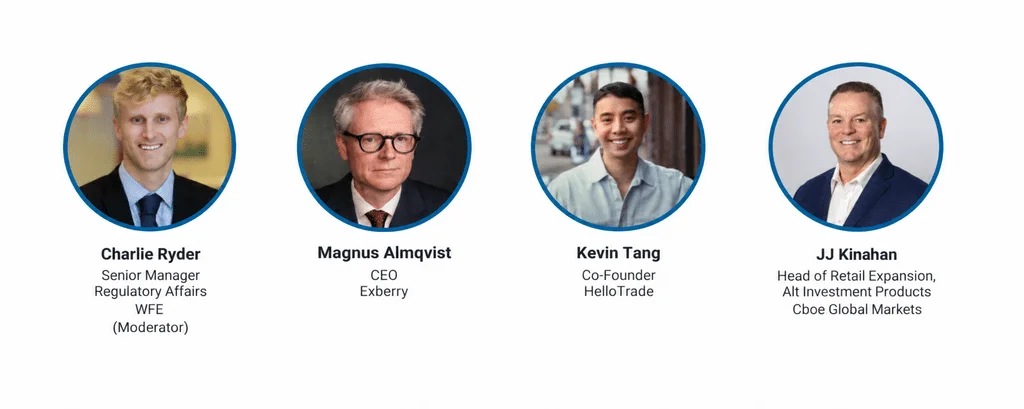
Those issues were discussed by JJ Kinahan, Head of Retail Expansion, Alt Investment Products at Cboe Global Markets; Kevin Tang, Co-Founder of HelloTrade; and Magnus Almqvist, CEO of Exberry, during a World Federation of Exchanges webinar on perpetuals and prediction markets. Charlie Ryder, Senior Manager, Regulatory Affairs at WFE, moderated the discussion.
Perpetuals trade simplicity for funding complexity
Tang linked the growth of crypto perpetual futures to capital efficiency, straightforward product design and the ability to trade continuously. Unlike a conventional futures contract, a perpetual has no set expiration date. Instead, periodic funding payments are used to help keep its price aligned with the underlying asset.
That mechanism is central to how perpetuals work, but it can complicate the experience for retail traders. Kinahan warned that a trader may correctly anticipate an asset’s price direction and still face a funding cost that affects the result, particularly when a position stays open for an extended period. His point is that understanding the market view is only part of understanding the position: traders also need to account for how funding accrues.
For platforms, the product’s apparent simplicity can therefore create an education challenge. The funding mechanism is not a one-time fee with a fixed amount known at entry; it can change the economics of holding a position. That distinction matters when comparing perpetuals with dated futures and options, whose structures and costs differ.
KPI contracts narrow the question
Kinahan described Cboe’s plans for contracts tied to corporate key performance indicators. Such contracts would let participants take a view on a defined company outcome rather than on the direction of the company’s shares as a whole.
That distinction addresses a familiar problem in equity trading: a company can report strong results while its share price falls, if expectations, guidance or other factors shape the market’s response. A contract tied to a KPI could focus exposure on the metric a participant is watching. As Kinahan put it, the product lets users form a view on “the areas of a company you’re actually observing.”
Cboe has said its focus is on events it considers financially relevant, rather than sports or entertainment outcomes. Kinahan compared the possible growth path for KPI contracts with the development of zero-days-to-expiration options, where retail interest helped attract market makers and later institutional participation. That comparison points to a possible sequence, not a guarantee: trading interest must be matched by liquidity and infrastructure before a product can support broader participation.
Clearing is one of the practical hurdles. Cboe’s usual options clearing route is through the Options Clearing Corporation, but Kinahan said the clearinghouse’s technology modernization meant it could not immediately accommodate the proposed contracts. Cboe therefore sought to use its own clearing infrastructure. At the time of the discussion, Kinahan said Cboe had permission for the product and was awaiting a decision on the clearing arrangements. That distinction shows how a product’s trading design and its post-trade setup can progress on separate timelines.
Liquidity and continuous operations shape platform design
For blockchain-based venues, Tang identified early liquidity as a major challenge. A new perpetual market needs capital, market makers and both buyers willing to take liquidity and participants willing to provide it. Without enough activity on both sides, trading can be difficult to start and sustain.
Tang said blockchain platforms can use trading incentives and open participation to attract liquidity. He also pointed to potential demand from people in emerging and frontier markets who have limited access to traditional brokerage services. The opportunity depends on whether platforms can provide usable markets and manage their risks; access alone does not solve liquidity or operational constraints.
Almqvist said longer trading hours place demands on more than the matching engine. Systems for collateral transfers, settlement and internal risk management must work as trading continues, and the components need to exchange information closely. In older arrangements, matching, collateral management and clearing may sit in separate systems. Continuous activity makes coordination among those functions more consequential, especially when prices move quickly or trading is concentrated around an event.
Infrastructure also has to absorb bursts in volume and support system upgrades without interrupting operations. Almqvist said firms need risk and settlement functions positioned close to the matching engine. For event-driven contracts, where activity may cluster around a specific outcome, the ability to handle sudden volume is part of whether a venue can maintain orderly trading.
Risk controls remain central to institutional use
Tang highlighted a particular challenge for perpetuals linked to traditional assets: reliable prices may not be available outside regular trading hours. He said venues need safeguards familiar from established markets, including price bands, limits on open interest and circuit breakers. These controls can help contain the effects of sharp moves, although their design must fit the product and the conditions in which it trades.
Kinahan stressed that a failure in risk management can undermine confidence in an entire market. That concern reaches beyond a single venue: participants judge unfamiliar products partly by whether platforms can manage positions, liquidity and disruptions under pressure.
Hedge funds and institutional market makers are already active in crypto derivatives, Tang said. Wider use of on-chain venues still faces barriers, including the work of connecting existing technology and compliance processes, as well as the risk of flaws in smart contracts. Tang identified smart contract risk as the biggest obstacle he sees for institutions considering on-chain trading.
Traditional portfolio managers are also watching perpetual prices over weekends for clues about where underlying markets may open when regular trading resumes. That use highlights how activity in one market can inform expectations in another, even when the venues and trading hours differ.
Kinahan expects ideas and firms from conventional derivatives and blockchain trading to converge as exchanges consider longer hours and changes to clearing. Tang likewise expects the two approaches to move closer as institutional participation grows. Neither expects the newer products to displace options and traditional futures. The next test is whether venues can pair new forms of exposure with dependable liquidity, clear cost structures and risk systems that hold up through continuous trading.