Amazon’s Million-Robot Network Adds a Physical Dimension to Its AI Spending
Amazon has more than a million fulfillment robots as it expands AI across warehouses and AWS, while rising investment weighs on free cash flow.
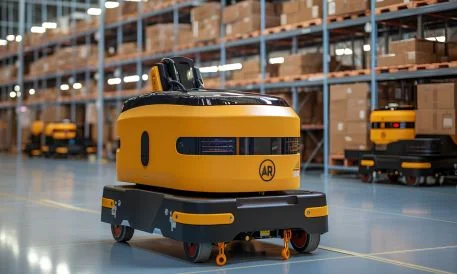
Amazon’s AI strategy now has a visible presence across its fulfillment network: more than a million robots are at work in its facilities. The scale matters because the company’s technology spending is extending beyond chips and data centers into the physical systems that move orders, a bet tied to productivity, delivery speed and operating costs.
The expansion comes as Amazon weighs substantial investment against the returns it can generate. The company expects approximately $220 billion in cash capital expenditures this year and meaningfully more in 2027. Its latest financial figures show strong revenue and operating income growth alongside a sharp reversal in trailing 12-month free cash flow, underscoring the near-term cost of building capacity.

Robots move from experiment to operating infrastructure
CEO Andy Jassy said Amazon’s current robot count is modest relative to what the company expects to achieve over the next five years. He described a continuing role for human employees in fulfillment centers, while anticipating that robots will take on more of the repetitive work people perform today.

That shift could reshape how Amazon staffs and operates its warehouses, though Jassy’s comments do not suggest that people will disappear from those facilities. The company’s stated focus is on tasks that are repetitive, with the potential gains measured in productivity, safety, cost and delivery time. Those measures will determine whether a deployment makes operational sense.

New fulfillment sites, including facilities designed to support same-day delivery, are expected to make extensive use of robotics. Amazon is also examining whether machines can help with the final hundred yards to customers’ doors. That remains an area under exploration, and the company has tied wider use to whether robots can improve the economics and performance of delivery.
Chief Financial Officer Brian Olsavsky said Amazon doubled its fleet of robotic arms, including Cardinal and Sparrow, in 2026. The company is also developing AI models intended to simplify robot programming and enable more complex physical tasks. Olsavsky credited robotics and AI with measurable gains in productivity and safety, although the source did not provide figures for those improvements.

For investors and operators, the million-robot milestone is a measure of deployment, not by itself proof of financial return. The business case depends on how much work the machines can handle, what they cost to install and maintain, and whether they improve throughput without creating new bottlenecks. Amazon’s focus on those operating outcomes gives a clearer test for the investment than the robot count alone.

AWS is selling the software layer for AI agents
Amazon is pursuing a parallel expansion in software through AWS. He said, “I believe virtually every modern enterprise production application will be rewritten to be agentically capable,” and argued that businesses will need these capabilities to work faster and address security risks.
AWS is positioning itself to provide both development tools and ready-to-use services. Jassy said tens of thousands of customers use Bedrock AgentCore. Customers deployed twice as many agents during the third quarter as in the prior three quarters combined, a sign of accelerating adoption within that service.
The company’s packaged offerings include Amazon Connect for contact centers and Amazon Transform for technology migrations. Jassy also pointed to rising use of the workplace assistant Amazon Q at companies including 3M and Southwest Airlines. Business customers, he said, want access to multiple AI models, with strong security and control over which users can access them.
That demand supports AWS’s effort to serve as a platform for enterprise AI adoption. It also gives customers a choice among models and tools within Amazon’s cloud services. The commercial opportunity will depend on whether businesses move from testing agents to using them in important workflows, and whether that use translates into recurring cloud demand.
Investment is testing the cash generation story
Amazon’s third-quarter revenue rose 12% to $201.9 billion, while operating income climbed to $28.1 billion from $17.4 billion. AWS sales increased 39% to $46 billion. Net income, by contrast, declined to $20.7 billion from $21.2 billion, primarily because investment gains had lifted the comparison period a year earlier.
Free cash flow provides a sharper view of the spending pressure. Over the trailing 12 months, it shifted from a $14.8 billion inflow to a $42.4 billion outflow, driven largely by investment in AI. The figures describe a company growing its core sales and operating income while committing large sums to infrastructure whose returns will take time to establish.
Jassy said AWS could become a trillion-dollar revenue business within five to 10 years. That is a long-range ambition, not a near-term result, and the company’s current investment plans put greater weight on future capacity. The next evidence to watch is whether AI services and warehouse automation translate into sustained operating gains as capital spending rises.