Derivatives Firms Weigh Perpetuals and 24/7 Markets as Demand Remains Limited
Most firms reported stronger first-half performance, but interest in 24/7 trading is concentrated among a minority of institutional clients.


Derivatives firms entered the second half of 2026 with generally stronger business performance, while their plans for perpetual futures and round-the-clock trading remained measured. Acuiti’s survey points to a market exploring new products and infrastructure, but with uneven client demand and unresolved questions about risk, collateral and operating costs.
Performance improved, with costs still a pressure point
In Acuiti’s inaugural Q3 2026 Derivatives Management Insight Report, two-thirds of surveyed firms said business performed better in the first half of 2026 than in the same period a year earlier. Only 12% reported worse performance. Against an average year, 64% said results were better, including 31% who described the half as significantly better.
Budget comparisons were positive for a smaller share: 52% came in above expectations, with 16% significantly ahead, while 19% fell below budget. Acuiti said sell-side members reported above-average performance relative to the wider listed derivatives market.
That strength did not remove operational pressures. Third-party technology vendor costs affected the largest group of respondents, followed by exchange fees. Regulation was a significant or critical challenge for 34%, including 11% who called it critical. Finding skilled staff ranked similarly, at 35%; rising salaries weighed on a further quarter.
Perpetual futures draw interest, but require new risk models
Among sell-side execution desks, 16% already offered perpetual futures. Another 10% were developing an offering and 37% were considering one. The remaining 37% had no plans to offer the products. Acuiti described perpetual futures as an increasingly visible part of traditional finance.
For firms weighing an entry, the central work is in adapting established futures operations. Risk management and modelling were the most commonly cited challenges, particularly around funding rates. Respondents also pointed to the need for suitable margin methodologies and dependable liquidity. Those requirements will shape whether interest turns into a viable service: adding a product means building a framework to manage its exposures through changing market conditions.
Institutional appetite for 24/7 trading is still narrow
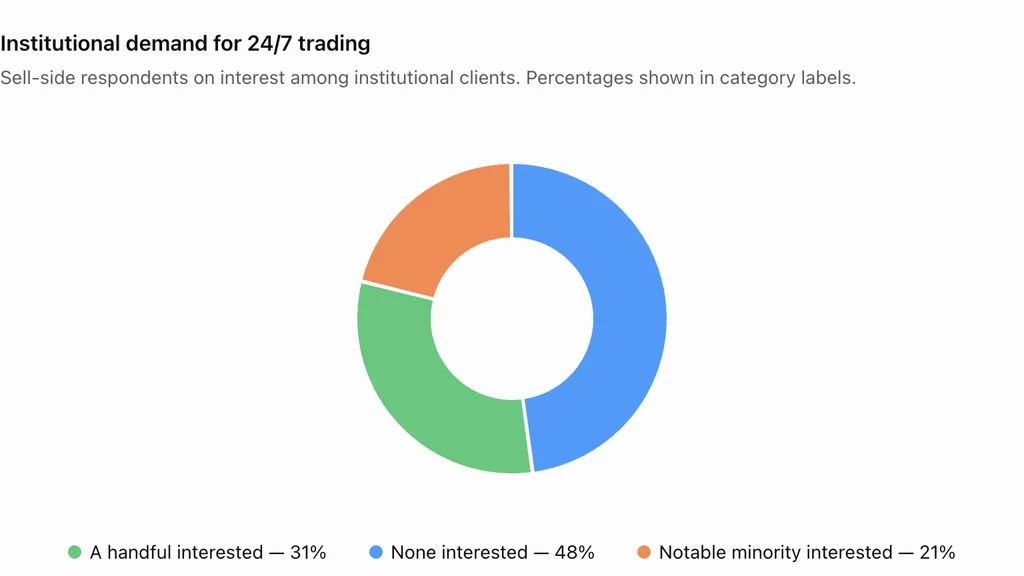
Client interest in round-the-clock trading was limited across the surveyed sell-side firms. Forty-eight percent said none of their institutional clients were interested; 31% reported interest from a handful, and 21% said a notable minority were interested. No respondents said most of their institutional clients wanted the functionality.

Stephanie Peritore, Head of International Sales at Fidelity Digital Assets, said the shift would require changes to the systems that support institutional markets. “Twenty-four hour markets fundamentally challenge many of the operating assumptions upon which traditional financial infrastructure has been built,” she said. Extending existing procedures across more hours would not be enough, she added: “adapting to 24/7 markets is not about extending existing processes around the clock; it is about redesigning infrastructure around automation.”
Proprietary trading firms were similarly cautious about weekend hours for traditional contracts such as oil futures. Sixty-five percent did not support extending those hours; 30% said they potentially supported it, and 5% were definite supporters.
When asked where they would prefer to trade weekend exposures, 73% chose traditional financial markets such as CME, versus 20% for native crypto markets and 7% for decentralized finance platforms. Acuiti said firms favored traditional venues because existing connectivity and potential margin efficiencies were already in place.
Stablecoin clearing hinges on liquidity and collateral certainty
For clearing firms, the case for stablecoins is connected to the limits of banking-hour payment rails, collateral transfers and treasury operations. Nineteen percent of respondents said stablecoins would be essential for 24/7 clearing, while 31% called them very important and 38% quite important. Thirteen percent said they were not important.
Those views come with practical conditions. Acuiti highlighted questions about eligible collateral, haircuts, custody, redemption and liquidity in stress or default scenarios. The test for clearing firms is whether stablecoins can deliver reliable funds and collateral when margin is due or assets must be realized quickly—not simply whether transfers can happen faster than fiat payments.
Peritore said blockchain alone would not produce the needed efficiencies. She pointed to the combination of distributed ledger technology with institutional-grade custody, governance, regulatory oversight, financing capabilities and operational controls.
Clearing ties and technology plans reflect a broader shift
Three-quarters of proprietary trading and buy-side respondents were satisfied with their existing number of FCM or GCM relationships and had no planned change. Sixteen percent were seeking more clearing broker relationships, while 2% planned to consolidate or reduce them. Access to new markets or products was the leading reason to review those ties, followed by cost and fee optimization; margin and capital efficiency also featured.
The report also considered how firms are approaching AI as its use spreads through derivatives businesses. Acuiti said it combined earlier reports into a market-wide publication because changes in market structure and technology—including AI, tokenisation and 24/7 trading—affect different parts of the industry.
Near-term sentiment was positive: 68% of network members were optimistic about derivatives business performance over the next three months, including 18% who were very optimistic and 50% quite optimistic. Another 29% were neither optimistic nor pessimistic; 2% were quite pessimistic and 1% very pessimistic.
Peritore’s closing point was that the value of always-on markets may depend less on trading frequency than on continuous management of liquidity, collateral and risk. For firms considering the change, infrastructure readiness and demonstrable client demand remain the practical measures to watch.
The report draws on an anonymized survey of Acuiti’s Derivatives Expert Network, whose senior members work across sell-side firms, hedge funds, asset managers and proprietary trading firms. It combines the organization’s earlier buy-side, proprietary trading, sell-side execution and clearing reports.