Codelco Dismisses Eight More Employees as Copper Reporting Review Widens
Eight more Codelco employees have been dismissed as reviews examine production discrepancies, reporting controls and pressure on the miner’s operations.
Eight more Codelco employees have been dismissed as investigations into copper production records widen, extending the impact of a reporting scandal at the Chilean miner. The departures reach several operating divisions and the company’s Santiago headquarters, and include senior managers responsible for production-related functions.
The dismissals affect Chuquicamata, Ministro Hales and Salvador. Salvador general manager Patricio Viveros is among those leaving, along with managers responsible for mineral resources and development at the three divisions. Codelco also dismissed Salvador’s smelter operations superintendent, the head of quality and metallurgical balance at Ministro Hales, and corporate managers responsible for mineral resources and development and metallurgical valuation.
Felipe Lagno will replace Viveros as Salvador’s general manager. Codelco said the latest personnel decisions do not rule out further disciplinary measures or legal action as its investigations continue. The changes respond to new evidence of irregularities, though the full scope of the discrepancies and how they arose remain under review.
What the production reviews found
The inquiry began with an internal review of December 2025 records. It identified approximately 20,000 tonnes of copper that had been entered as production without meeting the requirements for actual output. The first examination centered on Chuquicamata, where reviewers found inconsistencies in the validation of material classified as finished product.
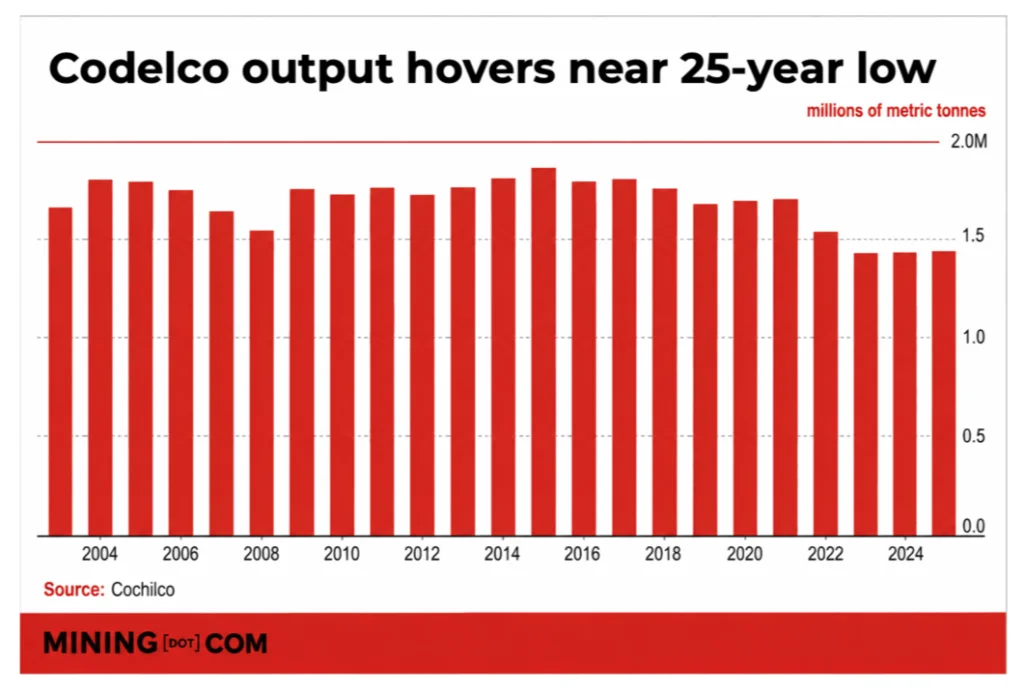
A later review identified roughly 27,000 tonnes of copper that had been incorrectly recorded as commercially ready material. That amount equaled about 2% of Codelco’s reported own-mine production in 2025. The findings led to an earlier executive dismissal, disciplinary action affecting other employees and a recalculation of incentives linked to output.
The two figures come from separate findings, and the available information does not establish that they represent wholly distinct volumes. The subsequent review also raised the possibility that the same copper had been counted as production by more than one division, potentially inflating reported output at Ministro Hales and Salvador during 2024 and 2025. Determining how much output was affected, and whether the records overlap, is central to the work still underway.
Codelco has said the irregularities did not require changes to its audited 2025 financial statements. That statement addresses the reported financial accounts; it does not resolve questions about the accuracy of divisional production measures, performance assessments or the controls used to verify operational data.
Credibility and operating pressures
The reporting questions arrive while Codelco is managing project delays, lower ore quality, rising costs and record-high debt. Those pressures make the reliability of production figures relevant beyond the immediate personnel changes. Customers and bondholders need a clear account of the company’s operating performance, while managers rely on comparable records to assess output and allocate resources.
Juan Ignacio Guzmán, chief executive of GEM Mining Consulting, told MINING.COM that the discrepancies suggest Chilean copper production has been overstated. He said the issue was unlikely to affect global copper markets, which respond to actual supply and demand. His principal concern was the company’s financing: “Naturally, a company that lacks credibility could face a very serious impact on its borrowing costs.”
Guzmán said financial markets generally continue to trust Codelco, and viewed the company’s disclosure of the irregularities and efforts to strengthen reporting controls as steps in the right direction. The cost of borrowing could still depend on how convincingly the company explains the gaps, documents its corrections and demonstrates that the revised controls work in practice.
Juan Carlos Guajardo, executive director of Plusmining consultancy, described the findings to MINING.COM as a serious test of internal control, traceability and operational validation. Those systems matter because production figures are built from material movements and processing stages across multiple sites. If records are not validated consistently, reported output can become difficult to compare across divisions and periods.
Reviews continue as leadership shifts
Codelco has engaged Ernst & Young to examine the scale of the discrepancies, identify those potentially responsible and assess their economic impact. KPMG is reviewing production records across the company, while Chile’s Comptroller General is undertaking a separate review. The conclusions of these examinations have not yet been released.
The scrutiny is also landing during a leadership transition. New chairman Bernardo Fontaine and chief executive Jorge Gómez are emphasizing the performance and consolidation of existing operations under a value-over-volume approach, a shift from the growth targets pursued by the previous leadership. That focus will be difficult to assess until the company can provide production figures that are both reliable and comparable.
Lower ore grades and delays at major projects already complicate the task of sustaining production. High debt also limits the room available to fund operational improvements and expansions. Those conditions increase the stakes of accurate reporting: managers, customers and lenders need to distinguish changes in recorded output from changes in the amount of copper actually produced.
The next useful evidence will be the external reviews’ account of how the discrepancies developed, whether the same material appeared in multiple divisional records, and what controls Codelco changes as a result. Until that work is complete, the eight new dismissals mark a widening response, while the scale and financial consequences of the reporting problem remain unsettled.